ISO 7176‑25 & ISO 7176‑31: Wheelchair Battery Charger Standards for OEM Manufacturers
Electric power wheelchairs and mobility scooters rely on safe, well‑matched battery‑charging systems. For wheelchair OEMs, medical equipment brands and component buyers, ISO 7176‑25:2022 and ISO 7176‑31:2023 define critical safety, performance, labelling and test rules for lead‑acid and lithium‑ion wheelchair battery chargers respectively.
Many product compliance failures stem from mixing‑up these two standards: ISO 7176‑25 applies exclusively to lead‑acid (SLA/AGM/GEL) systems, while ISO 7176‑31 covers lithium‑ion / LiFePO4 battery systems for powered wheelchairs.
Overview of ISO 7176 Standard Series
ISO 7176 is the core international standard suite for powered wheelchairs and mobility scooters, covering mechanical safety, EMC, battery, charger and human‑machine interface requirements.
Two parts directly govern charging hardware:
- ISO 7176‑25:2022: Lead‑acid batteries and chargers for powered wheelchairs — Requirements and test methods
- ISO 7176‑31:2023: Lithium‑ion battery systems and chargers for powered wheelchairs — Requirements and test methods
Note: Older editions ISO 7176‑25:2013 is superseded. Always reference the latest 2022 / 2023 version for new OEM projects.
ISO 7176‑25:2022 — Lead‑Acid Wheelchair Battery & Charger Standard
This standard specifies safety, performance, indicator, EMC and documentation rules only for SLA, AGM and Gel lead‑acid battery systems. Charger scope is limited to AC input ≤250V and DC output voltage ≤36V (so it does NOT cover 48V wheelchair chargers)
Mandatory charger requirements under ISO 7176‑25
- Electrical & performance safety
Multi‑stage charging profile for lead‑acid (bulk‑absorption‑float). Protection against over‑voltage, over‑current and short‑circuit must be implemented on charger hardware.
- Status indicator rules
Charger must provide clear visual indication for three states: normal charging active, charging complete, fault condition. LED colour coding is widely adopted in mobility industry (Red = power, Orange = charging, Green = full).
- Setting‑lock requirement
If charger supports multiple voltage / battery‑type modes, mode switch cannot be altered without tools or password; prevents end‑users from mis‑configuring charger for wrong battery chemistry.
- Documentation & labelling
Mandatory printed or manual information: output voltage, charging current, compatible battery chemistry, warnings for incorrect battery matching.
- EMC compliance
Charger shall meet electromagnetic compatibility requirements referenced to ISO 7176‑21.
Real‑world OEM application
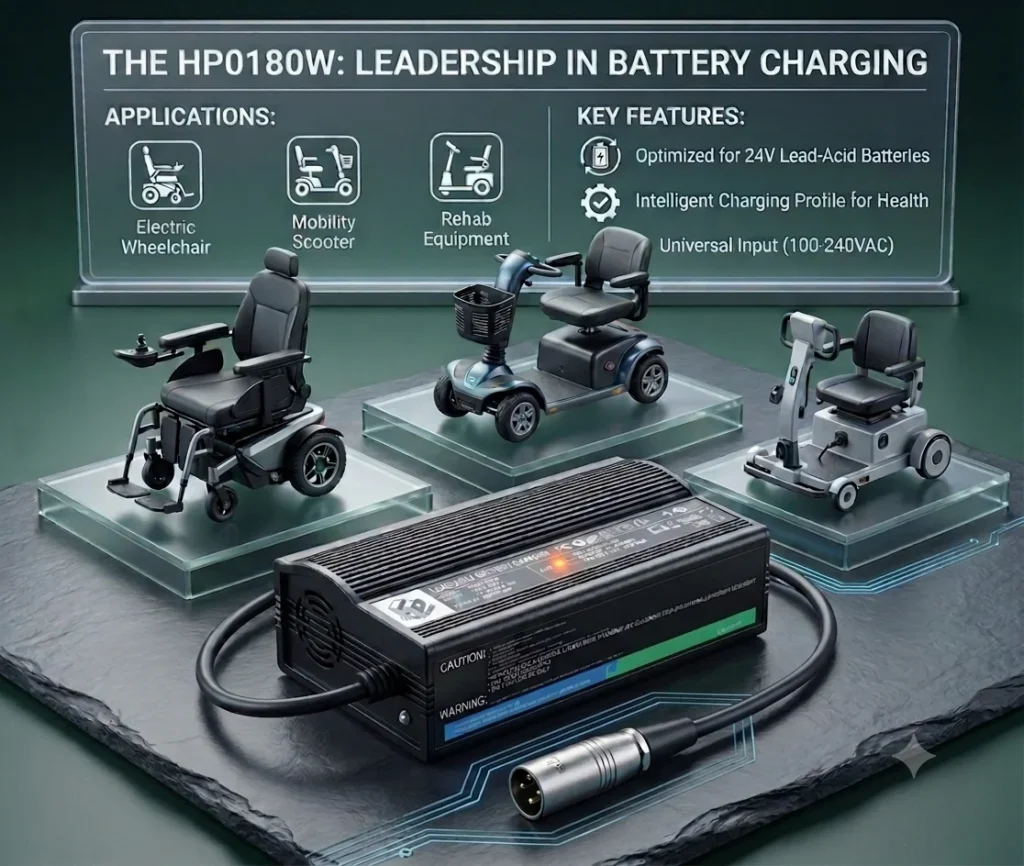
The HP8204B 24V 6A wheelchair charger is a typical 24V lead‑acid mobility charger designed against ISO 7176‑25 requirements, widely adopted for power wheelchairs and mobility scooters.
ISO 7176‑31:2023 — Lithium‑ion Battery Systems & Chargers for Wheelchairs
As lithium‑ion and LiFePO4 packs become mainstream for premium wheelchairs, ISO 7176‑31 defines safety for full lithium battery system including battery pack, BMS and matching charger hardware.
Critical point: ISO 7176‑31 treats the whole wheelchair power system as one unit. It also addresses regenerative charging risk — when wheelchair rolls downhill, motor feedback voltage may charge lithium battery outside normal charger control.
Key mandatory clauses for charger & system
- BMS mandatory protection functions
Cell over‑voltage, under‑voltage, over‑current, over‑temperature and under‑temperature protection are compulsory for lithium battery packs used on wheelchairs. Cell balancing is recommended.
- Charger connector specification
For XLR‑style mobility connectors: charger output shall use male (pin‑out) connector, to avoid pin‑short hazards. Inter‑mateability test is required to prevent accidental cross‑connection between lead‑acid and lithium chargers
- Charging algorithm restriction
No float charging for lithium‑ion systems. CC‑CV constant‑current constant‑voltage profile is required.
- Fire & thermal‑runaway mitigation
References IEC 62133‑2 and IEC 62619 for lithium‑ion cell safety and fire containment requirements.
- Documentation requirement
Full test report, system integration notes, warning against mixing non‑compliant third‑party chargers.
ISO 7176‑25 vs ISO 7176‑31 Quick Comparison Table
| Item | ISO 7176‑25:2022 | ISO 7176‑31:2023 |
|---|---|---|
| Target Battery Chemistry | SLA / AGM / GEL Lead‑Acid | Lithium‑ion / LiFePO4 |
| Typical Nominal System Voltage | 12 V, 24 V, 36 V (max scope) | 24 V / 36 V /48 V lithium wheelchair packs |
| Core Charging Algorithm | 3‑stage Bulk‑Absorption‑Float | 2‑stage CC‑CV, float not permitted |
| Focus Area | Charger safety, indicator, labelling, test methods | Full battery‑wheelchair system, BMS, connector, thermal runaway, regenerative charging risk |
| Connector Rules | XLR connector mechanical requirements | Strict male‑pin output requirement, cross‑chemistry mis‑plug prevention |
| Applicable Output Voltage Limit | ≤ 36 V DC | No hard DC‑output upper limit defined in this standard |
Practical OEM Guidance: How to use these two standards in your wheelchair project
- Select correct standard based strictly on battery chemistry
- Lead‑acid → follow ISO 7176‑25:2022
- Lithium‑ion / LiFePO4 → follow ISO 7176‑31:2023
Never apply ISO 7176‑25 charger design for lithium‑ion battery packs.
- Request these deliverables from your charger OEM supplier
- Test reports referencing corresponding ISO‑7176 part and edition
- Complete specification sheet stating compatible battery chemistry
- Connector mechanical drawings (especially for XLR customisation)
- Warning text samples for product label & user manual.
- Cross‑reference other relevant standards
- ISO 7176‑21: EMC for wheelchair and battery chargers
- IEC 60601‑1: If your device is classified as medical‑grade mobility equipment, charger also needs medical safety compliance.
ELITE‑HP Wheelchair Battery Charger Solutions
ELITE‑HP designs OEM mobility chargers aligned with ISO 7176‑25 and ISO 7176‑31 project requirements for power wheelchairs and mobility scooters.
Our product portfolio supports both lead‑acid and lithium‑ion mobility applications:
HP1211B(L2) | 24V 4A Wheelchair Battery Charger
Suitable for entry‑level lead‑acid powered wheelchairs and mobility scooters, designed following ISO 7176‑25 requirements.
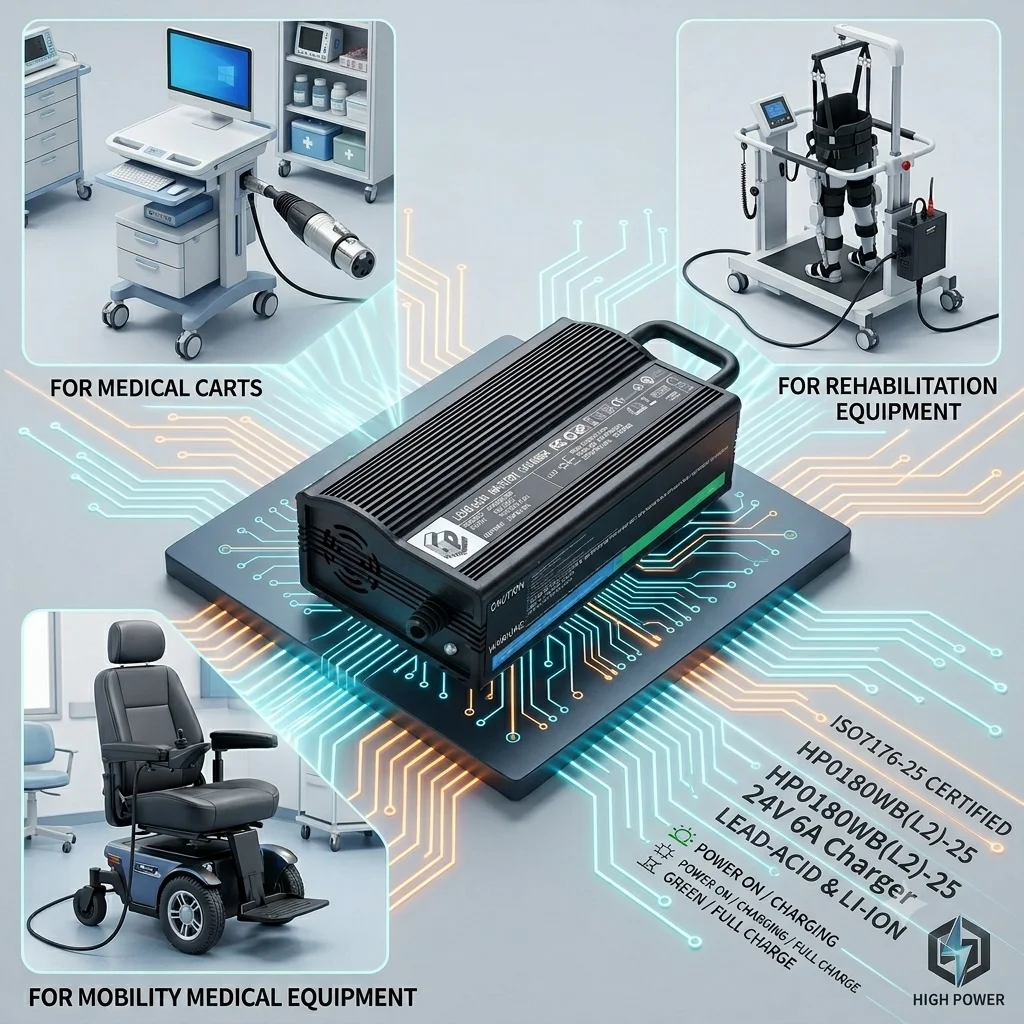
HP0180WB(L2) | 24V 6A Medical‑Grade Battery Charger
For OEM medical mobility devices, supports SLA batteries and meets ISO 7176‑25 plus IEC 60601‑1 medical‑grade safety requirements.
FAQ
Q: Can I use an ISO 7176‑25 lead‑acid charger for LiFePO4 wheelchair battery?
A: Not allowed for compliant OEM products. ISO 7176‑25 chargers implement float‑charge stage, which will damage lithium‑ion cells and violate ISO 7176‑31 safety requirements.
Q: Does ISO 7176‑25 apply to 48 V mobility chargers?
A: No. ISO 7176‑25 scope only covers DC output ≤ 36 V, 48 V lead‑acid wheelchair chargers fall outside this standard.
Q: Are ISO 7176‑25 /‑31 mandatory legal requirements worldwide?
A: They are harmonised product standards. For medical mobility devices sold in EU / UK market, compliance with these standards can be used to demonstrate product safety for CE / UKCA marking.
Q: What is the difference between ISO 7176‑31 and IEC 60601‑1?
A: ISO 7176‑31 is wheelchair‑specific lithium battery system standard; IEC 60601‑1 is general medical electrical equipment safety standard. Medical wheelchair OEM often need to satisfy both.
Conclusion
ISO 7176‑25:2022 and ISO 7176‑31:2023 define baseline safety for powered‑wheelchair charging hardware. ISO 7176‑25 targets lead‑acid systems while ISO 7176‑31 addresses lithium‑ion battery systems including BMS, connector safety and downhill regenerative‑charging hazards.
For OEM wheelchair manufacturers, choosing a charger supplier familiar with these two standards reduces compliance risk and speeds‑up your product certification process. Contact ELITE‑HP to discuss your mobility charger OEM project.
Related Products
HP1211B(L2) 24V4A Wheelchair Battery Charger
Have Questions About Chargers?
Our engineering team is ready to help. Send us your inquiry — we respond within 24 hours.
Response within 24 hours
Need a Customized Wheelchair Battery Charger?
Elite-HP has specialized in medical, wheelchair, and mobility scooter chargers since 1993. Get your quotation within 24 hours.