How to Choose the Right E-Bike Battery Charger: Voltage, Current and Charging Guide
Learn how to choose the right e-bike battery charger based on battery voltage, chemistry, charging current, connector type, and charging requirements. A complete guide for 36V, 48V, and 52V e-bike batteries.
Choosing the right e-bike battery charger is essential for safe, reliable, and efficient charging.
An e-bike charger must be compatible with the battery’s:
- Voltage
- Chemistry
- Charging voltage
- Charging current
- Connector
- Battery Management System (BMS)
Using an incompatible charger can result in charging failure, battery damage, or safety risks.
Whether you are an individual e-bike owner, distributor, or OEM manufacturer, understanding these specifications will help you select the right electric bike battery charger.
1. Identify Your E-Bike Battery Type
Before selecting a charger, first identify the battery chemistry.
The most common battery types used in e-bikes include:
- Lithium-ion (Li-ion)
- Lithium Iron Phosphate (LiFePO4)
- Lead-acid batteries
Lithium-ion is the most common battery technology in modern e-bikes.
Lithium-Ion (Li-ion) Batteries
Standard lithium-ion batteries typically use cells with a maximum charging voltage of approximately 4.2V per cell.
Common e-bike battery systems include:
| Nominal Battery Voltage | Typical Cell Configuration | Full-Charge Voltage | Typical Charger Output |
|---|---|---|---|
| 36V | 10S | 42.0V | 42.0V |
| 48V | 13S | 54.6V | 54.6V |
| 52V | 14S | 58.8V | 58.8V |
For example, a typical 48V lithium-ion e-bike battery requires a 54.6V charger.
A 52V lithium-ion battery typically requires a 58.8V charger.
The charger voltage must match the battery’s required full-charge voltage.
Lithium Iron Phosphate (LiFePO4) Batteries
LiFePO4 batteries use a different charging voltage from standard lithium-ion batteries.
A typical LiFePO4 cell has a maximum charging voltage of approximately 3.65V.
For example:
| Nominal Battery System | Typical Configuration | Full-Charge Voltage |
|---|---|---|
| 48V LiFePO4 | 16S | 58.4V |
| 52V LiFePO4 | 17S | 62.05V |
The exact charging voltage should always be confirmed with the battery manufacturer.
A charger designed for standard lithium-ion batteries should not automatically be used with a LiFePO4 battery.
Lead-Acid Batteries
Lead-acid batteries are less common in modern e-bikes but may still be found in some older or specialized electric vehicles.
Common types include:
- SLA
- AGM
- Gel
Lead-acid batteries require a dedicated charging profile.
The charging voltage depends on:
- Battery configuration
- Battery chemistry
- Charging profile
Therefore, do not select a lead-acid charger based only on nominal battery voltage.
2. Match the Charger Voltage
One of the most important rules when choosing an e-bike charger is:
The charger output voltage must be compatible with the battery’s required charging voltage.
For example:
A typical:
- 36V Li-ion battery → 42V charger
- 48V Li-ion battery → 54.6V charger
- 52V Li-ion battery → 58.8V charger
The nominal battery voltage and charger output voltage are not necessarily the same.
For example, a battery marketed as a 48V lithium-ion battery normally requires a charger with a 54.6V output.
Using a charger with an incorrect output voltage can result in:
- Charging failure
- Battery damage
- BMS protection activation
- Potential safety risks
Always confirm the battery manufacturer’s charging specifications before selecting a charger.
3. Choose the Correct Charging Current
Charging current is measured in amperes (A).
Common e-bike charger outputs include:
- 2A
- 3A
- 4A
- 5A
- 6A
- 8A
In general:
Higher current → Faster charging
Lower current → Longer charging time
However, the battery must be designed to accept the selected charging current.
For example, a high-capacity battery may support a higher charging current than a small battery pack.
The appropriate current depends on:
- Battery capacity
- Battery chemistry
- Cell specifications
- BMS limitations
- Thermal management
- Manufacturer recommendations
4. Standard Charging vs Fast Charging
There is no universal definition of “fast charging” for every e-bike battery.
A 5A charger may be considered fast for a small 10Ah battery but relatively moderate for a 30Ah battery.
Therefore, charging current should be considered together with battery capacity.
For example:
A 10Ah battery charged at 5A:
5A ÷ 10Ah = 0.5C
A 20Ah battery charged at 5A:
5A ÷ 20Ah = 0.25C
This shows why charging current should not be evaluated independently.
Fast charging may reduce charging time, but the battery must be specifically designed to support the higher current.
5. How Long Does It Take to Charge an E-Bike Battery?
A simple estimate can be calculated as:
Charging Time ≈ Battery Capacity (Ah) ÷ Charger Current (A)
For example:
A 48V 15Ah battery with a 3A charger:
15Ah ÷ 3A = approximately 5 hours
A 48V 15Ah battery with a 5A charger:
15Ah ÷ 5A = approximately 3 hours
However, actual charging time may be longer.
Near full charge, the charger may reduce the charging current. Battery temperature and charging efficiency can also affect the total charging time.
Therefore, this formula provides only a general estimate.
6. E-Bike Charger Connector Types
The connector is another important part of charger compatibility.
Common e-bike charger connectors include:
Barrel Connectors
Common in many consumer and entry-level e-bikes.
Different barrel connectors may have different:
- Diameters
- Lengths
- Polarity configurations
Therefore, connectors that look similar are not necessarily compatible.
XLR Connectors
Some electric mobility and specialty applications use XLR connectors.
The number of pins and wiring configuration must be confirmed before use.
GX Series Connectors
GX connectors are used in some e-bike and electric mobility applications.
The exact connector model and pin configuration should be checked.
Proprietary Connectors
Some major e-bike brands use proprietary charging connectors.
In these cases, the charger must be specifically designed for the vehicle or battery system.
7. Standard OEM E-Bike Chargers
An OEM charger is designed or supplied for a specific battery or e-bike system.
Advantages include:
- High compatibility
- Correct charging profile
- Reliable operation
- Designed electrical specifications
For most e-bike users, using the charger recommended by the battery or e-bike manufacturer is the safest option.
For OEM manufacturers, working with a charger supplier allows the charger to be customized for the specific battery system.
8. Fast E-Bike Chargers
Fast chargers use a higher charging current to reduce charging time.
They may be suitable for:
- High-capacity batteries
- Commercial e-bike fleets
- High-use applications
- Performance e-bikes
However, fast charging should only be used when supported by the battery manufacturer.
Before selecting a high-current charger, confirm:
- Maximum battery charging current
- BMS capability
- Battery thermal management
- Charger compatibility
A higher-current charger should never be selected simply because it provides faster charging.
9. Smart and Programmable E-Bike Chargers
Some specialized charging systems provide advanced control over:
- Charging voltage
- Charging current
- Charging stages
- Charging profiles
These solutions can be useful for OEM development and specialized applications.
However, adjustable voltage does not automatically mean that one charger can safely charge every battery.
The charging parameters must always be configured according to the battery chemistry and battery manufacturer’s specifications.
10. Portable E-Bike Chargers
Portable chargers are designed for riders who need a compact solution for travel or temporary charging.
Typical portable chargers may offer:
- Compact size
- Lower weight
- Lower charging current
For example, a portable 2A charger may be easier to carry than a larger high-current charger.
However, portability often comes with a trade-off in charging speed.
11. E-Bike Battery Charging Safety Tips
Follow these guidelines when charging an e-bike battery.
Use a Compatible Charger
Always use a charger designed for the specific battery system.
Check the Charging Voltage
Confirm the charger’s output voltage matches the battery’s required charging voltage.
Check the Charging Current
Make sure the battery supports the charger’s charging current.
Consider Temperature
Follow the battery manufacturer’s recommended charging temperature range.
Lithium batteries generally should not be charged below 0°C unless the battery system is specifically designed for low-temperature charging.
Use Proper Ventilation
Keep the charger in a suitable environment during operation.
Inspect the Charger and Cable
Stop using the charger if you notice:
- Damaged cables
- Burn marks
- Unusual odors
- Abnormal overheating
Follow the Battery Manufacturer’s Instructions
The battery manufacturer’s specifications should always take priority.
12. Recommended E-Bike Chargers by Battery System
The following table provides general examples.
| E-Bike Battery System | Battery Chemistry | Typical Charger Output | Example Charging Current |
|---|---|---|---|
| 36V | Li-ion | 42V | 2A–4A |
| 48V | Li-ion | 54.6V | 2A–5A |
| 52V | Li-ion | 58.8V | 2A–8A |
| 48V | LiFePO4 | 58.4V | Application dependent |
| 52V | LiFePO4 | Approximately 62.05V | Application dependent |
These are general reference values.
The correct charger should always be selected according to the battery manufacturer’s specifications.
13. Frequently Asked Questions
Can I use a higher-current charger to charge my e-bike faster?
Only if the battery and BMS are designed to support the higher charging current.
A higher-current charger should not be used simply to reduce charging time.
Why does my e-bike charger get warm?
Some heat during normal operation is common.
However, excessive heat, abnormal odor, or repeated thermal shutdown may indicate a problem.
Ensure that the charger has adequate ventilation and is used according to the manufacturer’s instructions.
Can I use a 54.6V charger for a 52V battery?
A typical 52V lithium-ion battery requires a full-charge voltage of 58.8V.
Therefore, a 54.6V charger designed for a typical 48V lithium-ion battery is generally not suitable for a 52V lithium-ion battery.
Always check the battery specifications before selecting a charger.
Can I use the same charger for Li-ion and LiFePO4 batteries?
Not necessarily.
The two battery chemistries use different charging voltages and charging characteristics.
The charger must be compatible with the specific battery chemistry and configuration.
How can I extend my e-bike battery life?
Follow the battery manufacturer’s charging recommendations.
Avoid:
- Incorrect chargers
- Excessive heat
- Extreme temperatures
- Long-term storage at very high or very low charge levels
For long-term storage, follow the battery manufacturer’s recommended state of charge.
14. OEM E-Bike Battery Charger Solutions
For e-bike manufacturers and distributors, a standard off-the-shelf charger may not always meet project requirements.
OEM charger projects may require customization of:
- Output voltage
- Charging current
- Charging profile
- DC connector
- Cable length
- Housing
- Label
- Packaging
An experienced OEM e-bike charger manufacturer can help develop a charger based on the specific battery system.
Elite-HP provides OEM battery charger solutions for different mobility applications and can support projects requiring customized electrical specifications and connectors.
For manufacturers, we can evaluate charger requirements based on:
- Battery voltage
- Battery chemistry
- Battery capacity
- Charging current
- Connector
- Target market
- Certification requirements
Conclusion
Choosing the right e-bike battery charger requires more than simply matching the battery’s nominal voltage.
The key factors include:
- Battery chemistry
- Nominal voltage
- Full-charge voltage
- Charging current
- Battery capacity
- BMS compatibility
- Connector type
- Charging environment
For example, a typical:
36V Li-ion battery → 42V charger
48V Li-ion battery → 54.6V charger
52V Li-ion battery → 58.8V charger
However, these are typical examples, not universal rules.
Always verify the exact battery specifications before selecting a charger.
For e-bike manufacturers and distributors, an experienced OEM charger supplier can provide customized solutions based on the battery system and application requirements.
Related Products
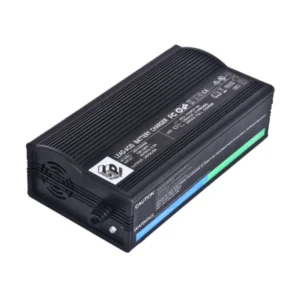
HP0420D(L4)F 48V7A E-bike Battery Charger
Have Questions About Chargers?
Our engineering team is ready to help. Send us your inquiry — we respond within 24 hours.
Response within 24 hours
Need an OEM E-Bike Battery Charger?
Elite-HP has specialized in medical, wheelchair, and mobility scooter chargers since 1993. Get your quotation within 24 hours.