The Ultimate Guide to E-Mobility Battery Chargers: E-Bike, E-Scooter, E-Motorcycle and Wheelchair Chargers
Learn how to choose the right e-mobility battery charger for e-bikes, electric scooters, electric motorcycles, and wheelchairs. Compare voltage, charging current, battery chemistry, connectors, and charger types.
E-mobility is rapidly expanding across personal transportation and mobility applications.
From e-bikes and electric scooters to electric motorcycles and powered wheelchairs, rechargeable batteries have become an essential part of modern transportation and mobility equipment.
However, not every battery charger is compatible with every vehicle.
Choosing the wrong charger can result in:
- Charging failure
- Longer charging times
- Reduced battery performance
- Battery damage
- Safety risks
Whether you are an individual user, mobility equipment distributor, or OEM manufacturer, understanding the relationship between battery voltage, charging voltage, charging current, battery chemistry, and connector type is essential.
This guide explains how to choose the right e-mobility battery charger for different applications.
1. What Is an E-Mobility Battery Charger?
An e-mobility battery charger is a power conversion device designed to recharge batteries used in electric mobility applications.
Common applications include:
- E-bikes
- Electric scooters
- Mobility scooters
- Electric motorcycles
- Electric wheelchairs
- Other light electric vehicles
The charger converts AC power from the electrical grid into the appropriate DC charging output required by the battery system.
A complete charging system may include:
AC Input
↓
Battery Charger
↓
Charging Connector
↓
Battery Management System (BMS)
↓
Battery Pack
Each part must be compatible with the others.
2. E-Mobility Vehicle Types and Their Charging Requirements
Different electric vehicles use different battery systems and charging specifications.
The following table provides general examples.
| Vehicle Type | Common Battery System | Typical Charging Voltage* | Typical Charging Current | Common Connector Types |
|---|---|---|---|---|
| E-Bike | 36V, 48V, 52V | 42V, 54.6V, 58.8V | 2A–8A | Barrel, XT60, Proprietary |
| E-Scooter | 36V, 48V, 60V | 42V, 54.6V, 67.2V | 2A–10A | Barrel, XLR, GX16, Proprietary |
| E-Motorcycle | 48V, 72V, 96V | Application dependent | 5A–20A+ | Anderson, Proprietary, Vehicle-specific |
| Electric Wheelchair | 24V, 36V, 48V | Application dependent | 2A–10A | XLR, Proprietary, Other |
* Charging voltage depends on battery chemistry and cell configuration. It is not necessarily the same as the battery’s nominal voltage.
For OEM projects, the charger should always be selected based on the actual battery specification, not simply the nominal voltage printed on the battery pack.
3. Battery Voltage vs Charging Voltage
One of the most important concepts in e-mobility charging is the difference between nominal battery voltage and full-charge voltage.
For example, a lithium-ion battery pack may be described as a 48V battery system.
However, its full-charge voltage may be significantly higher than 48V.
A typical 48V lithium-ion battery pack using standard 4.2V lithium-ion cells may have a full-charge voltage of approximately:
54.6V
Therefore, a suitable charger may be specified as:
54.6V charger for a 48V lithium-ion battery pack
The same principle applies to other battery systems.
For example:
| Nominal Battery System | Typical Full-Charge Voltage for Standard Li-ion |
|---|---|
| 24V | 29.4V |
| 36V | 42.0V |
| 48V | 54.6V |
| 52V | 58.8V |
These values are examples for standard lithium-ion cell configurations. Other battery chemistries, such as LiFePO4, use different charging voltages.
Always confirm the battery manufacturer’s specifications before selecting a charger.
Using a charger with the wrong output voltage can cause charging failure or create a safety risk.
4. Battery Chemistry Matters
Voltage is only one part of charger compatibility.
The battery chemistry must also match the charger’s charging profile.
The most common battery technologies used in e-mobility applications include:
- Lithium-ion
- LiFePO4
- Sealed Lead Acid (SLA)
- AGM
- Gel batteries
Lithium-Ion Battery Chargers
Lithium-ion batteries generally require a controlled charging process.
A typical lithium-ion charging profile includes:
- Constant Current (CC)
- Constant Voltage (CV)
The battery pack may also include a Battery Management System (BMS) to provide protection and monitor battery conditions.
The charger and battery system should be designed to work together.
LiFePO4 Battery Chargers
LiFePO4 batteries use a different charging voltage compared with standard lithium-ion batteries.
Therefore, a standard lithium-ion charger should not automatically be used with a LiFePO4 battery.
The charger must match:
- Battery chemistry
- Cell configuration
- Charging voltage
- Charging current
Lead-Acid Battery Chargers
Lead-acid batteries remain common in:
- Mobility scooters
- Electric wheelchairs
- Medical mobility equipment
Common types include:
- SLA
- AGM
- Gel
These batteries require their own charging profiles and should be charged using a compatible battery charger.
5. Charging Current Determines Charging Speed
Charging current is measured in amperes (A).
For example:
- 2A charger
- 3A charger
- 5A charger
- 6A charger
- 10A charger
In general, a higher charging current can reduce charging time.
However, the maximum charging current must be supported by the battery.
For example, if a battery is rated for a maximum charging current of 3A, using a 10A charger is not an appropriate solution.
The correct charging current depends on:
- Battery capacity
- Battery chemistry
- Battery cell design
- BMS limitations
- Manufacturer specifications
- Thermal management
Therefore, faster charging is not always better.
6. What Is C-Rate?
The C-rate describes charging or discharging current relative to battery capacity.
For example:
A 10Ah battery charged at 5A:
5A ÷ 10Ah = 0.5C
A 20Ah battery charged at 10A:
10A ÷ 20Ah = 0.5C
However, the acceptable C-rate varies by battery chemistry and battery design.
Therefore, there is no universal rule that:
0.5C is always slow charging.
Instead, the battery manufacturer should specify the recommended and maximum charging current.
7. Standard Charging vs Fast Charging
E-mobility chargers can generally be grouped into several categories.
Standard OEM Charger
Standard chargers are normally designed specifically for a particular battery system.
Advantages include:
- High compatibility
- Reliable charging
- Designed charging profile
- Good everyday solution
These chargers are commonly supplied with:
- E-bikes
- Electric scooters
- Mobility scooters
- Electric wheelchairs
For most applications, using the charger recommended by the vehicle or battery manufacturer is the safest approach.
Fast Charger
Fast chargers provide a higher charging current to reduce charging time.
They may be useful for:
- Commercial fleets
- High-use mobility equipment
- Professional applications
- Users who need shorter charging cycles
However, fast charging should only be used when the battery system is designed to support it.
Considerations include:
- Maximum charging current
- Battery temperature
- BMS capability
- Battery lifespan
- Charger thermal performance
Smart or Programmable Charger
Smart chargers may provide more advanced charging control.
Depending on the application, features can include:
- Multiple charging stages
- Automatic charging control
- Battery condition monitoring
- Communication with the battery system
These solutions are often more suitable for specialized OEM applications than general consumer use.
Portable and Solar Charging Solutions
Portable or solar-powered charging systems can be useful in specific off-grid applications.
However, they require careful system design.
The solar panel, power controller, battery charger, and battery must all be compatible.
For most e-mobility applications, a dedicated AC battery charger remains the simplest and most reliable solution.
8. Choosing the Right Charger for Different E-Mobility Applications
E-Bike Battery Charger
Common systems include:
- 36V
- 48V
- 52V
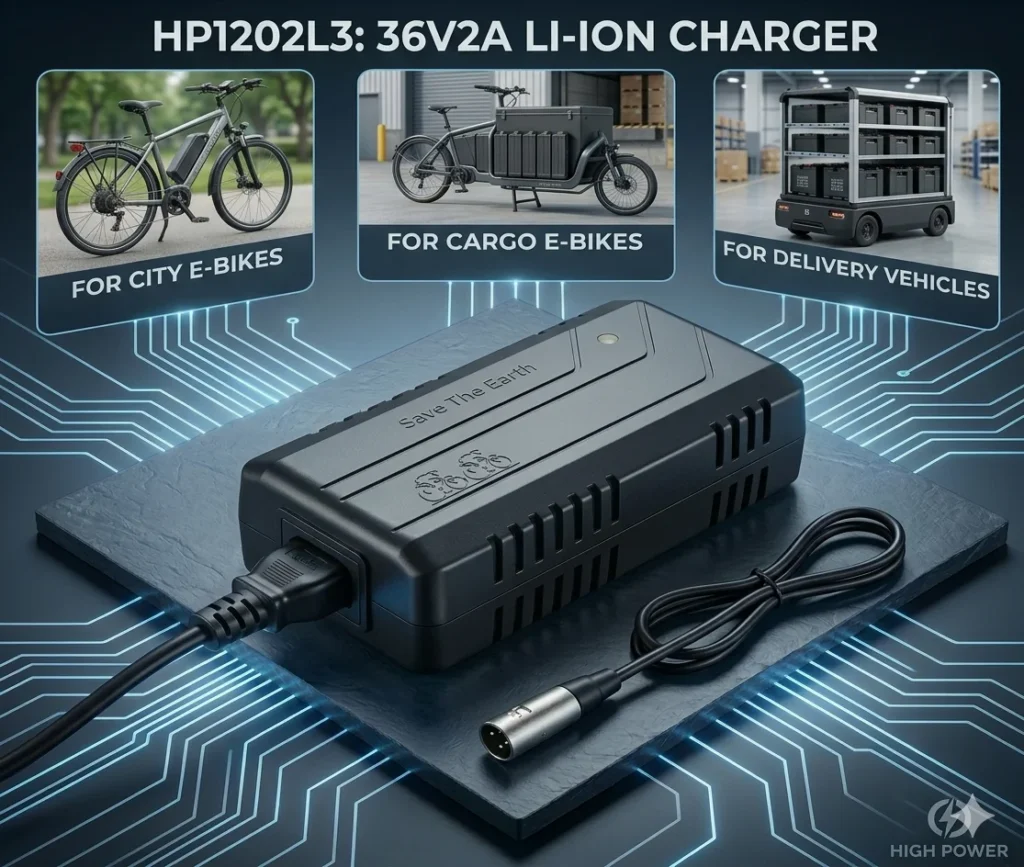
A 48V lithium-ion e-bike battery, for example, may require a 54.6V charger.
Typical charging current depends on battery capacity and manufacturer requirements.
Common options include:
- 2A
- 3A
- 4A
- 5A
- Higher-current OEM solutions
Electric Scooter Charger
Electric scooters may use:
- 36V
- 48V
- 60V
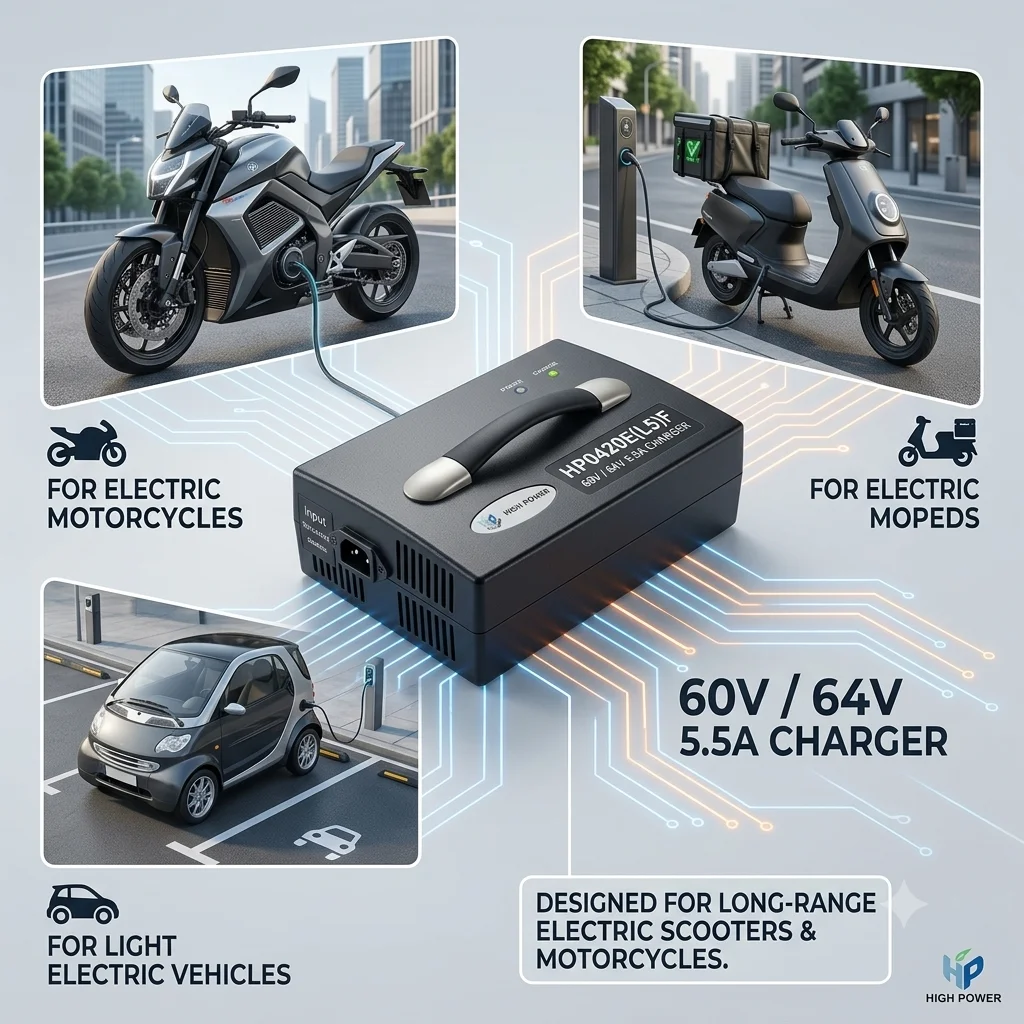
A 60V lithium-ion battery system may require a charger with an output voltage of approximately 67.2V.
The correct charger should be selected according to:
- Battery chemistry
- Battery capacity
- Charging voltage
- Charging current
- Connector
Electric Motorcycle Charger
Electric motorcycles typically use higher-capacity battery systems.
Common battery systems may include:
- 48V
- 72V
- 96V
Higher-capacity batteries may require higher charging currents.
OEM manufacturers should consider:
- Charging power
- Thermal management
- Battery communication
- BMS requirements
- Charging connector
For high-power electric motorcycles, charging solutions should be engineered specifically for the vehicle and battery system.
Electric Wheelchair and Mobility Scooter Charger
Electric wheelchairs and mobility scooters commonly use:
- 12V
- 24V
- 36V
- 48V
Battery chemistries may include:
- SLA
- AGM
- Lithium-ion
The charger should be matched to both the battery voltage and chemistry.
For example:
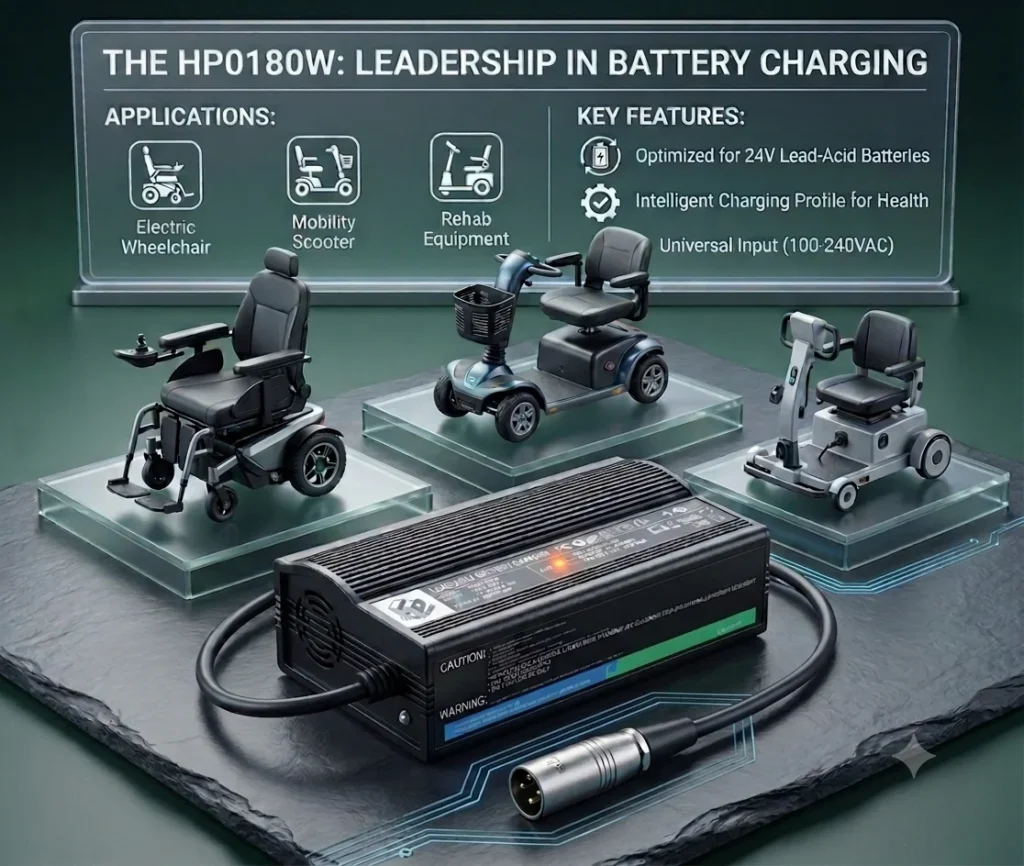
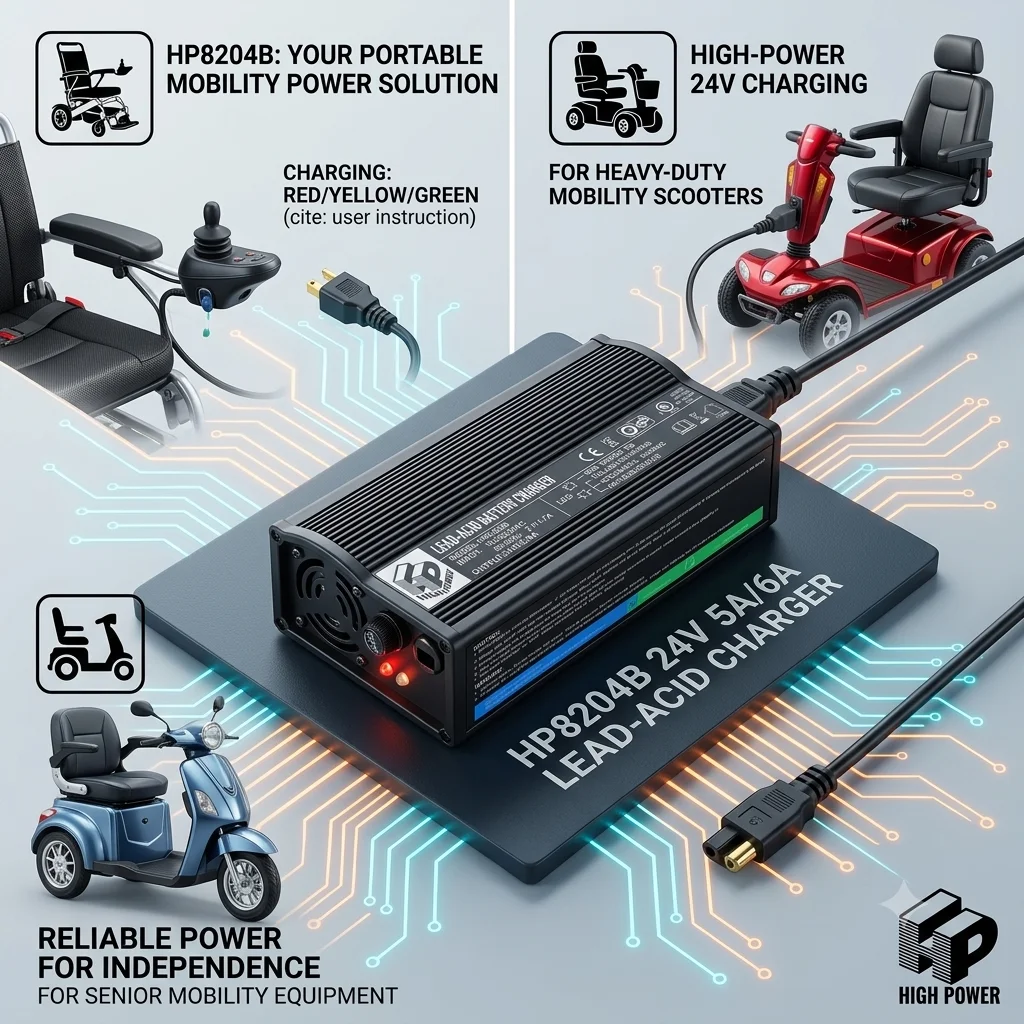
A 24V mobility application may use a 24V 2A, 4A, 6A, or 8A charger depending on battery capacity and charging requirements.
Elite-HP provides OEM battery charger solutions for electric wheelchairs and mobility scooters.
9. Common E-Mobility Charger Connectors
The connector is another important consideration.
Common options include:
Barrel Connectors
Often used in:
- E-bikes
- Electric scooters
- Small mobility devices
XLR Connectors
Common in:
- Electric wheelchairs
- Mobility scooters
- Medical mobility equipment
GX Series Connectors
Used in some:
- E-scooters
- Light electric vehicles
Anderson Connectors
Used in some higher-current battery applications.
The connector must match:
- Mechanical dimensions
- Pin configuration
- Polarity
- Current rating
Never assume that two connectors are compatible simply because they look similar.
10. How to Choose the Right E-Mobility Battery Charger
Before selecting a charger, confirm the following information:
Step 1: Identify Battery Voltage
Is it:
- 24V?
- 36V?
- 48V?
- 52V?
- 60V?
- 72V?
Step 2: Identify Battery Chemistry
Is it:
- Lithium-ion?
- LiFePO4?
- SLA?
- AGM?
- Gel?
Step 3: Check Full-Charge Voltage
Do not select a charger based only on nominal battery voltage.
Step 4: Confirm Charging Current
Check the battery manufacturer’s recommended charging current.
Step 5: Check Connector
Confirm:
- Connector type
- Pin configuration
- Polarity
Step 6: Check Certifications
For medical mobility applications, additional requirements may apply.
Examples include:
- IEC 60601
- ISO 7176
- CE
- UL
- FCC
11. E-Mobility Charger Safety Tips
For safe and reliable charging:
Use a Compatible Charger
Always use a charger designed for your battery system.
Avoid Extreme Temperatures
Follow the battery manufacturer’s recommended charging temperature range.
Lithium batteries generally should not be charged below 0°C unless the battery system is specifically designed for low-temperature charging.
Do Not Mix Chargers
Do not use a charger designed for a different battery voltage or chemistry.
Check the Connector
Make sure the connector is properly matched to the battery system.
Follow Battery Manufacturer Instructions
The battery manufacturer’s specifications should always take priority when selecting charging current and charging conditions.
12. OEM E-Mobility Battery Charger Solutions
For e-mobility manufacturers, selecting an OEM charger supplier is different from purchasing a standard consumer charger.
OEM customers may require customization of:
- Output voltage
- Charging current
- Charging profile
- Connector
- Cable
- Housing
- Label
- Packaging
- Certification
A professional OEM battery charger manufacturer should also be able to support:
- Sample development
- Technical documentation
- Product testing
- Certification requirements
- Mass production
Elite-HP provides OEM battery charger solutions for a range of mobility applications, including:
- Electric wheelchairs
- Mobility scooters
- E-bikes
- Electric mobility equipment
Our charger solutions can be developed according to specific battery voltage, current, connector, and application requirements.
Conclusion
Choosing the right e-mobility battery charger requires more than matching the number printed on the battery.
The most important factors include:
- Nominal battery voltage
- Full-charge voltage
- Battery chemistry
- Charging current
- Battery capacity
- BMS compatibility
- Connector type
- Safety and certification requirements
Whether you are selecting an e-bike charger, electric scooter charger, mobility scooter charger, electric motorcycle charger, or wheelchair battery charger, the charger should always be matched to the complete battery system.
For everyday users, the manufacturer’s recommended OEM charger is usually the best starting point.
For OEM manufacturers and distributors, working with an experienced battery charger supplier can help ensure reliable charging performance, product compatibility, and long-term supply.
Related Products
Have Questions About Chargers?
Our engineering team is ready to help. Send us your inquiry — we respond within 24 hours.
Response within 24 hours
Need an OEM E-Mobility Battery Charger?
Elite-HP has specialized in medical, wheelchair, and mobility scooter chargers since 1993. Get your quotation within 24 hours.